
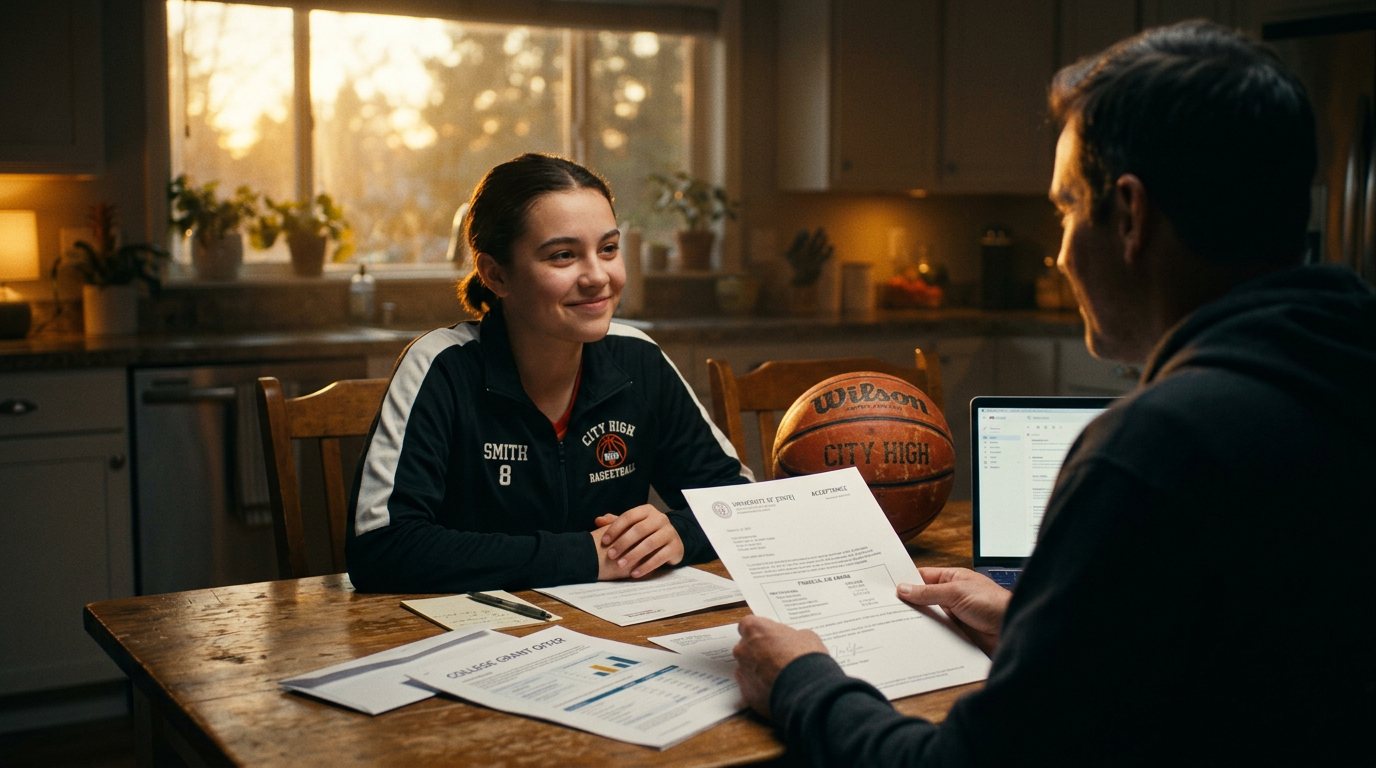
Every year a family sits across from me, deflated, because the D1 offers didn't come. And almost every time, the moment I say the words "Division III," I watch their faces drop a little — like I just told them to give up. "No scholarship, Coach? What's the point?" That reaction right there is the single biggest misunderstanding in all of D3 basketball recruiting, and it costs good players a great four years.
After 30-plus years developing athletes — guys who went D1, guys who signed pro contracts, and plenty who built wonderful college careers at every level in between — I can tell you the truth: Division III is the largest level of college basketball in the country, the hoops are legitimate, and for the right player it's one of the smartest paths there is. The catch is that D3 recruiting runs on a completely different engine than D1 or D2. If you try to recruit it the same way, you'll spin your wheels. So let's break down how it actually works.
What makes D3 basketball recruiting different
Here's the first thing every family needs to understand. Division III schools do not offer athletic scholarships — that's an NCAA rule, not a school-by-school choice. According to the NCAA, "Division III schools do not offer athletics scholarships." Full stop. No coach at that level can dangle an athletic ride, because none of them have one to give.
But read the rest of what the NCAA says, because this is where families stop too early: roughly 75 percent of Division III student-athletes receive some form of merit or need-based financial aid. That aid doesn't come from the basketball budget — it comes from academics, from merit awards, from need-based grants, from the institution's financial aid office. So a strong student at a D3 school can end up with a package that rivals, and sometimes beats, a partial athletic offer at a D2 or NAIA program. The money is real. It just has a different name on it.
That one fact changes the entire recruiting strategy. At D1 and D2, you're selling a coach on your basketball value so he'll spend scholarship dollars on you. At D3, you're running two campaigns at once: convincing a coach you can help his team and getting admitted and awarded by a school where your transcript does a lot of the heavy lifting. Your grades aren't a side note in D3 recruiting. They're currency.
The recruiting rules are more relaxed — use that
Here's the good news about D3. The contact rules at the Division III level are far more flexible than D1 or D2. Coaches can talk to you earlier and more freely, there are fewer dead periods and restrictions choking off communication, and in a lot of cases you can get a real conversation going with a head coach without jumping through the hoops that bigger programs put up.
That's a gift, and most families waste it. Because D3 coaches can respond to you directly and early, your outreach matters enormously. A thoughtful, specific email to a D3 coach — one that shows you know his program, his roster, and why you fit — can start an actual relationship, not an auto-reply. These coaches are often running leaner staffs with smaller recruiting budgets, which means they rely on players who identify themselves and make the first move.
Translation: at D3, the recruit who reaches out intelligently has a structural advantage. You are not waiting to be discovered. You're introducing yourself to a coach who is genuinely allowed, and often happy, to talk back.
Who D3 basketball is actually for
Let me be honest about fit, because that's what matters more than any logo.
Division III is a phenomenal path if you want real basketball without it becoming your entire identity. The lifestyle is more balanced than D1 — you'll practice, lift, travel, and compete hard, but you'll also have room to pursue a double major, an internship, study abroad, or a second passion. D3 schools include some of the best academic institutions in the country, and that degree and that alumni network will be paying you back for 40 years after your last game.
D3 is also the right call for the late bloomer whose game is ahead of his recruiting profile, the player who values a specific academic program, and the family for whom the total cost of attendance — tuition minus merit and need-based aid — pencils out better than a "partial" offer somewhere else. I've watched kids turn down the shiny label for the D3 school that fit, and almost none of them regret it.
Who should think twice? The player whose only goal is the highest level of exposure and professional basketball, and who would be miserable at a school he picked for academics. That's a real consideration — just make it with clear eyes, not out of pride.
How to get recruited at the D3 level
Here's the system I'd give any family targeting Division III.
1. Get an honest read on your level first
Before you fall in love with a school, know where you can actually play. Watch film of the programs you like and ask the unemotional question: would I be in this rotation, or just on this roster? D3 competition ranges from elite national contenders to developmental programs, so "D3" is not one level — it's a wide band. Target the part of it where you're a genuine fit.
2. Treat academics as part of your recruiting pitch
At D3, your transcript opens doors and unlocks aid. Keep your grades up, take the right core courses, and when you talk to coaches, be ready to share your GPA and test scores, because they're often thinking about admissions and merit money right alongside your jump shot. A strong student is an easier recruit for a D3 coach to bring in.
3. Build a target list that spans the band
Make a list of reach, match, and safety programs within D3 — and honestly, include some NAIA and D2 schools too, because the right financial and basketball fit doesn't always respect division lines. Weigh roster need at your position, the coach's style, academic programs, distance from home, and total cost after aid.
4. Reach out directly, early, and specifically
Use the relaxed D3 contact rules. Email coaches yourself, reference their actual program, attach real film, and be concrete about why you fit. Then follow up. The players who get recruited at this level are almost always the ones who made the first, best move.
5. Visit, and run the real numbers
Get on campus, sit in on a practice if you can, and ask the financial aid office for a concrete estimate. Compare total out-of-pocket cost across your options rather than comparing the words "scholarship" and "no scholarship." That comparison surprises a lot of families — in a good way.
Where WON Recruit fits in
This is exactly the kind of problem we built WON Recruit to solve. Most families guess at their level and aim at the wrong division entirely. Our free AICE Score — the Athlete Intelligence Career Engine — gives you an honest, data-based read on where you can realistically compete, so you know whether you're a D3 match, a reach, or should be looking across the band. From there we map you against 1,300-plus college programs by roster need and fit, so your D3 target list is built on where you'd actually contribute — not just the schools you've heard of.
And because D3 recruiting rewards the player who reaches out first, WON Recruit lets you email college coaches directly from your own inbox. For any athlete under 18, a parent or guardian approves every single message before it sends, so families stay in control of the whole process.
The bottom line
Don't let "no athletic scholarship" end the conversation. Division III is the biggest level of college basketball we have, the aid is real even if it comes from academics instead of the basketball budget, the recruiting rules are built in your favor, and the right D3 school can hand you both a great four years and a degree that pays off for decades. The families who win D3 basketball recruiting are the ones who understand the game being played — and then play it on purpose.
If you don't yet know where you honestly fit, start there. Get your free AICE Score, build a target list across the right levels, and go recruit like you have a plan — because now you do.
— Coach Brey, WON Recruit
Recruiting rules, scholarship models, and eligibility requirements change over time and by governing body. Division III has its own registration path and process — always confirm current requirements directly with the NCAA Eligibility Center before making decisions.