
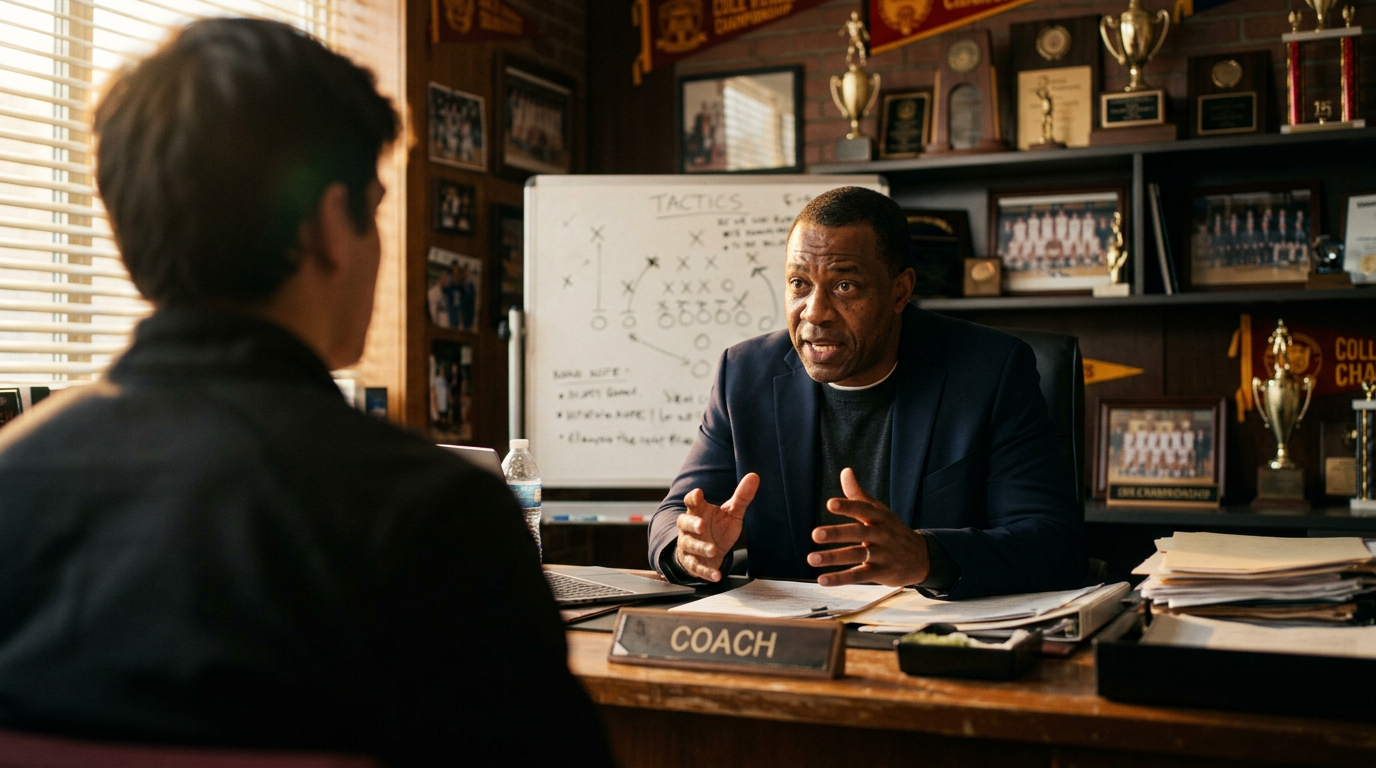
Most recruits walk into a phone call or a campus visit ready to be sold to. They expect the coach to do the talking — the pitch, the vision, the highlight reel of the program — and they nod along, hoping to come off as coachable and grateful. I understand the instinct. But after 30-plus years developing players, some who earned Division I scholarships and a few who went on to sign professional contracts, I can tell you the families who choose well are the ones who flip that script. They come with their own list. They understand that the right questions to ask college basketball coaches tell you more about a program in ten minutes than a glossy visit tells you in two days.
A recruitment is not a one-way audition. It is a two-way interview. The coach is deciding whether you fit their roster, and you are deciding whether you want to hand this person four of the most important years of your life. Act like it. Here are the questions that actually matter, grouped by what you're really trying to learn, plus how to read the answers you get back.
Treat the call like a two-way interview
Before we get to specific questions, understand the mindset. You are not being rude or ungrateful by asking hard questions — you are showing a coach that you're serious, that you think about your future, and that you'll be a mature presence in their locker room. Good coaches respect it. The ones who bristle when you ask a fair question are telling you something important about how they'll treat you once you've signed.
A few ground rules. Write your questions down beforehand so you don't freeze. Ask open-ended questions, not yes-or-no ones — "how" and "what" and "walk me through" pull real answers out of people. And listen harder than you talk. The gold is usually in how a coach answers, not just what they say.
The best questions to ask college basketball coaches about your role
This is where most families are too shy, and it costs them. You need to understand how the staff actually sees you, because "we love your game" is not a plan.
- "Where do you see me fitting in your system, and at what position?" You want to hear something specific. A coach who has genuinely evaluated you can describe the exact role. A vague answer means you're a name on a list, not a priority.
- "Realistically, what does my first year look like?" Ask for the honest version. Redshirt? Rotation minutes? Developmental year? You're not looking for a promise of starting — you're looking for honesty and a real picture.
- "Who else are you recruiting at my position, and how many are on the roster ahead of me?" This is the question that separates informed families from hopeful ones. Roster need is everything. A program that already has three returning guards at your spot is a very different opportunity than one losing two seniors.
- "What would I need to improve to earn minutes here?" A coach who answers this crisply already has a development plan for you — a green flag.
Be wary of any staff that promises you a starting spot or specific minutes before you've played a single practice. No honest coach can guarantee that, and the ones who do are selling, not coaching.
Questions about development — the part that outlasts your eligibility
I built my career on player development, so this is the section I'd push hardest on if you were my own kid. Your college years should make you better, not just busier.
Ask these:
- "How do you develop players in my position, and can you give me a concrete example?" You want names and specifics — a player who came in as one thing and left as another. Development you can point to beats development you're promised.
- "What does a typical week of individual skill work look like in and out of season?" This tells you whether development is a system or a slogan.
- "How do you handle the strength and conditioning side, and who runs it?" The weight room is where a lot of careers are quietly made.
Questions about academics and life after basketball
The overwhelming majority of college players do not play professionally — that's math, not pessimism, and it's why the degree matters as much as the minutes. Ask about the part of the deal that lasts a lifetime.
- "What academic support exists for athletes — tutoring, advising, study hall?"
- "What's the team's graduation rate, and how do players balance travel with their majors?"
- "Can I pursue the major I'm interested in, given our practice and travel schedule?" Some demanding majors are genuinely hard to combine with a Division I season. Better to know now.
- "What do your former players do after basketball? Where are they now?" A coach who stays connected to his alumni is a coach who cares about people, not just performers.
Questions about the scholarship, money, and the fine print
Money conversations feel awkward for families. Have them anyway — clearly and early.
- "Is this a full scholarship or a partial, and if partial, what exactly does it cover?" At the Division I level basketball scholarships are typically full, but roster and aid structures vary by division, and the recent changes to roster limits and athlete compensation have made these conversations more detailed than they used to be. Get specifics in plain language.
- "How are scholarships renewed, and under what circumstances would mine change?"
- "What does the NIL landscape look like here, and who helps athletes navigate it?"
- "What's the total cost to my family after aid?"
One important boundary: a coach is not your compliance office, and I'm not your lawyer. Rules around eligibility, aid, and amateurism change, and they differ across levels. Verify anything that affects your eligibility through the official NCAA Eligibility Center or the NAIA Eligibility Center rather than relying on a verbal answer in a recruiting pitch. Ask the coach for their honest read, then confirm the rules through the people whose job it is to know them.
Questions about culture, stability, and the people
You're joining a locker room and a staff, not just a logo. Dig into the human side.
- "How long is your contract, and do you expect to be here for my four years?" Coaching turnover is one of the biggest risks in recruiting. If the head coach leaves, your recruitment often doesn't transfer. You can't control it, but you can ask.
- "What's the culture of this team? How do players spend time together away from the gym?"
- "How do you handle discipline and playing time when a veteran and a freshman are even?"
- "Can I talk to a couple of current players without the staff in the room?" This might be the single most valuable request you can make. Players will tell you the truth about a program faster than any brochure.
How to read a coach's answers
The questions are only half of it. Learning to read the answers is the other half.
Green flags: specific answers, honest acknowledgment of challenges, a clear development plan, consistency between what the coach says and what current players say, and a willingness to tell you something you might not want to hear. A coach who levels with you during recruiting will level with you after you sign.
Red flags: vague generalities, guarantees no one can keep, pressure to commit on the spot, trash-talking other programs recruiting you, and answers that change depending on who's in the room. If a staff can't give you a straight answer now — while they're trying to win you over — imagine how straight they'll be once the courtship is over.
Match your questions to the level
The core questions above work everywhere, but weight them to the division. At the Division I level, lean into role, roster need, and development. At Division II, NAIA, and JUCO, ask hard about the financial package and the pathway — how players move up, transfer, or finish. At Division III, there are no athletic scholarships, so your questions shift toward academic aid, fit, and the overall experience. The smartest families ask the same foundational questions at every level and then listen for the differences.
The right questions start with knowing your level
Here's the thread running through all of this: good questions come from an honest understanding of where you actually fit. A family that knows a player is a realistic mid-major recruit asks sharper, more productive questions than a family chasing programs three levels above their game. The conversation only gets honest once your expectations are grounded.
That's exactly what we built WON Recruit to give you. Every athlete starts with a free AICE Score — an Athlete Intelligence Career Engine evaluation that scores where you can realistically play — and from there we map you against 1,300+ college programs to build a target list based on real roster need and fit. When you know your level and your target list is honest, you walk into every coach conversation asking the questions that actually move your recruitment forward.
Come to the call prepared. Ask the hard questions. Listen to the answers underneath the answers. The program you choose will shape the next four years of your life — so make them earn it, starting with a free AICE Score and a target list worth asking real questions about.